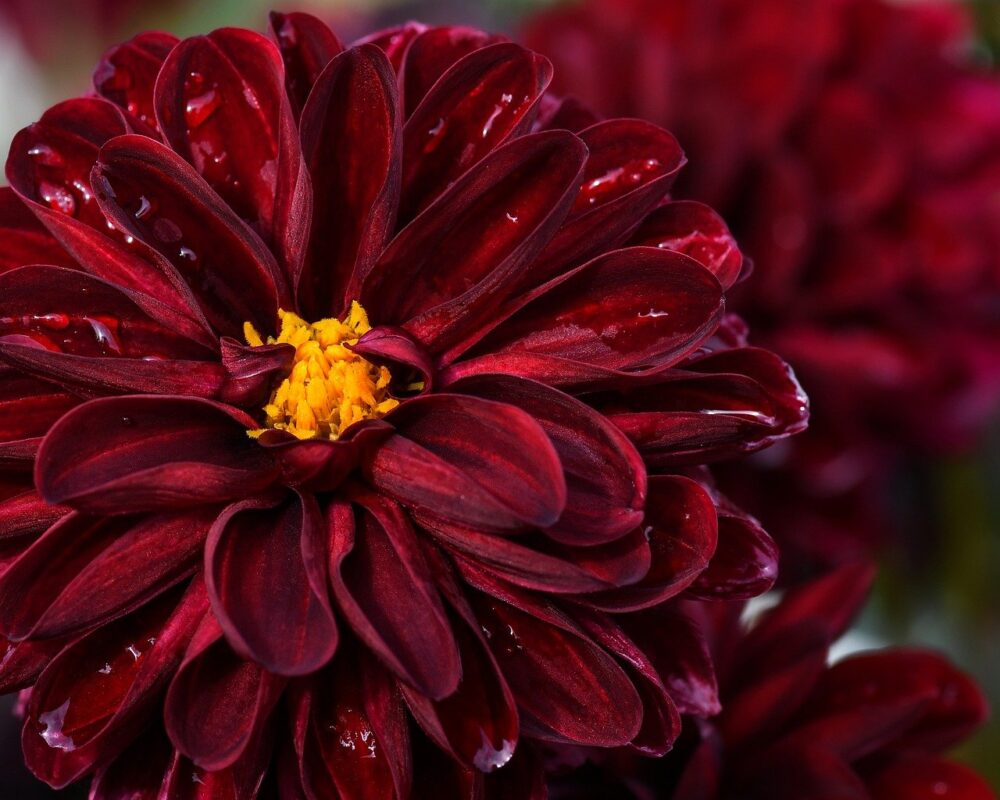
Powdery mildew on dahlias isn’t random, and it’s not just a “fungus problem.” It’s a system signal.
Most commonly in dahlias, powdery mildew is driven by Golovinomyces cichoracearum. It lands as spores, waits for the right conditions, then colonizes the leaf surface and taps into the plant’s energy through specialized feeding structures.
The fungus doesn’t create the problem, it exploits it.
What Powdery Mildew Actually Needs
For PM to establish on dahlias, three things must align:
- Humidity swings (warm days → cool nights → condensation)
- Low airflow (dense canopy, stagnant air)
- A metabolically weak plant
Most growers focus on the first two. The real leverage is the third.
The Real Weak Point: Plant + Microbiome Disconnect
A dahlia leaf is not just tissue, it’s an extension of a biological system:
Microbiome → Plant → Flower.
When that system is functioning properly:
- The plant is producing sugars (high brix)
- Microbes are cycling nutrients efficiently
- Calcium is being delivered and placed correctly in the tissue
- The leaf becomes structurally and metabolically resistant
When it’s not:
- Nutrients are present but not biologically available
- Calcium is in the soil but not in the plant
- The leaf becomes soft, low-energy, and accessible
That’s when powdery mildew gets in.
Calcium: The Gatekeeper (But Only When Biology Is Working)
You’ll hear “calcium prevents mildew” — that’s incomplete. Calcium only works when it is biologically delivered and placed correctly.
In a functioning system, calcium:
- Strengthens cell walls
- Regulates stomatal function
- Controls cellular signaling and defense
When calcium is truly sufficient inside the leaf, powdery mildew cannot penetrate and feed.
But here’s the mistake most growers make:
- Adding calcium ≠ fixing calcium
- Availability ≠ uptake
- Uptake ≠ utilization
Without an active microbiome, calcium stays locked or poorly cycled.
Dahlias Specifically: Why They’re Prone
Dahlias grow fast, soft, with high water content and dense canopies. That means:
- High demand for calcium
- High demand for microbial coordination
- High sensitivity to humidity swings
If biology isn’t keeping up with growth, you get soft tissue + low brix + weak defense = mildew target.
The Mycogasm Approach: Fix the System, Not the Symptom
1. Attenuate the Environment
- Increase airflow through pruning or spacing
- Avoid late-day watering
- Reduce humidity traps in dense dahlia canopies
This reduces pressure, but doesn’t solve the root issue.
2. Build and Direct the Microbiome (Biostimulant Layer)
Powdery mildew is often a sign of:
- Low microbial diversity
- Poor nutrient cycling
- Weak signaling between plant and microbes
This is where Mycogasm Biostimulant  comes in:
- Increases microbial density and diversity
- Breaks down biofilm and dead zones in the rhizosphere
- Improves nutrient flow and signaling
Biology isn’t just present — it becomes coordinated.
3. Increase Plant Energy (Foliar Metabolism Layer)
A high-energy plant resists disease naturally. Armor (foliar):
- Increases photosynthesis
- Raises brix (sugar levels)
- Strengthens plant metabolism
Higher brix = stronger immune response + less pathogen success.
This is critical in dahlias where rapid growth can outpace metabolism.
4. Fix Calcium the Right Way (Structure + Biology Together)
For dahlias under mildew pressure:
- Cal-Pack + → provides usable calcium
- Russian Thistle Ferment → helps biologically process and deliver calcium into plant tissue
This combo:
- Improves cell wall strength
- Increases fruit/flower integrity
- Enhances stress resistance
Calcium becomes functional — not just present
Active Infection Strategy (System Reset)
If powdery mildew is already showing:
Correct environment immediately
- Increase airflow
- Reduce humidity spikes
Rebuild biology
- Apply Mycogasm to root zone
Boost plant metabolism
- Foliar Armor to raise brix quickly
Restore calcium function
- Combine Cal-Pack + and Russian Thistle Ferment
You are not “killing mildew” — you are removing the conditions that allow it to exist.
Final Truth
You don’t spray your way out of powdery mildew. You grow your way out of it.
When:
- Biology is diverse and directed
- Calcium is functional
- The plant is metabolically strong
Powdery mildew becomes non-viable.
Want to Master This for Your Own Garden?
Understanding the theory is one thing, but applying biological systems to a unique dahlia patch is where the real magic happens. If you’re tired of chasing symptoms and want to learn how to build a truly resilient, high-brix growing system, Heber Hall is available for direct consultations and specialized training.
Whether you are a commercial flower farmer or a dedicated home grower, Heber can help you:
- Diagnose your specific system to find the actual limiting factors: whether it’s mineral tie-ups or microbial gaps.
- Design a custom protocol using the Mycogasm worldview to shut down disease pressure permanently.
- Master the “Biological Eye” so you can learn to read what your dahlias are telling you before the mildew even shows up.
Don’t just buy products — invest in the knowledge to treat the issue yourself and never look back. Reach out today to schedule a consultation and take control of your grow.