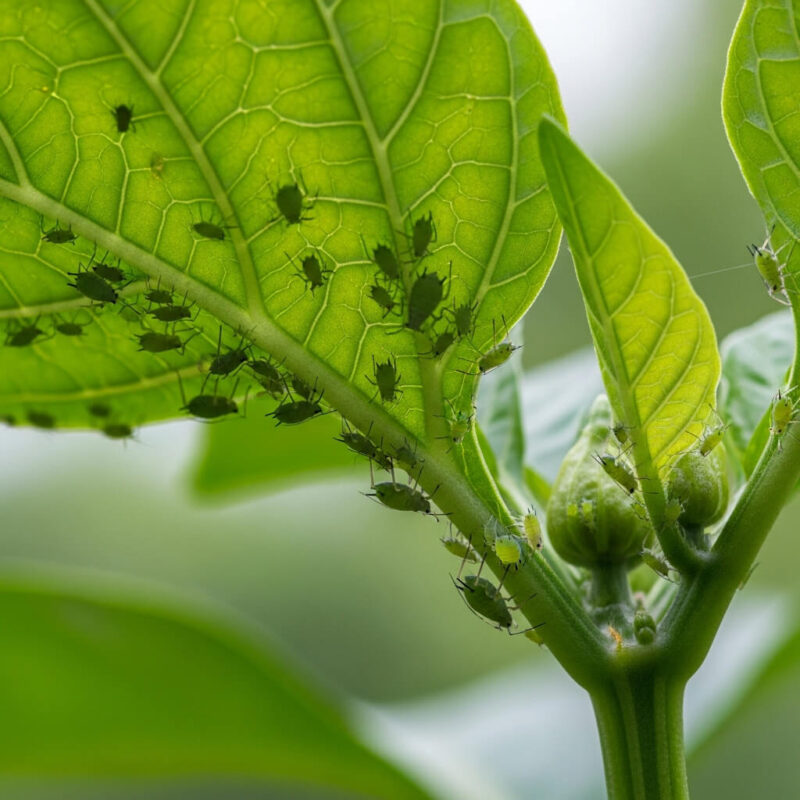
Aphids are a sap-sucking insect. They feed on low-brix plants exclusively.
They cannot attack a plant above ~6 brix without literally crystallizing.
Aphids have a very simple digestive system. They are not designed to process sugars to any meaningful degree. If they consume sap that’s too high in sugar (and it doesn’t take much), they die almost instantly. They die so fast they don’t even leave the plant — they get stuck right where they’re feeding as a crystallized mass of sugar and pest.
We call these candied aphids.
Why aphids show up on the newest pepper growth
On peppers, you’ll almost always see them on the newest flush of growth. Why? Because that new growth hasn’t reached full photosynthetic capacity yet. It’s softer, less mineralized, and typically running lower brix than mature leaves.
That’s the entry point.
There are a few reasons for this, but it all comes back to micronutrient availability and biological function.
It’s a nitrogen-form problem, not a nitrogen-amount problem
Aphids are primarily after ammonium forms of nitrogen in the plant.
When you push nitrogen — especially in peppers, which respond aggressively to it — without having the biology and micronutrients to process it, you create a buildup of unconverted nitrogen.
That’s an invitation.
Plants need:
- Molybdenum, cobalt, and sulfur — to convert nitrogen into amino acids and proteins
- Magnesium — center of the chlorophyll molecule (no Mg = no efficient photosynthesis)
- Manganese — carbon fixation (building sugars from CO₂)
- Boron — moves sugars into new growth
If these aren’t available or functional:
- Nitrogen accumulates instead of being converted
- Sugar production drops
- Sugar movement to new growth is limited
- New pepper growth becomes weak, soft, and attractive
That’s exactly where aphids show up.
The part most people miss: form, not quantity
Here’s the important part most people miss:
Those minerals are usually already in your soil or system. But they’re not in the right form.
Many of these elements have multiple oxidative states, and plants can only use them in their reduced (bioavailable) form.
Who does that conversion? Microbes.
If your microbiome is weak, unfed, or undirected:
- Minerals stay locked up
- Nitrogen stays in ammonium form
- Photosynthesis is inefficient
- Brix stays low
- And aphids move in
Low-brix plants don’t feed microbes well, and weak microbial systems can’t unlock nutrients. That’s the feedback loop.
So what do we actually do?
You don’t fix aphids directly. You fix the plant–microbe system.
1. Get biology functioning (Mycogasm  )
)
You need to:
- Break down biofilm and residue
- Stimulate beneficial fungi and bacteria
- Increase microbial density and communication
This is what starts unlocking minerals and correcting nitrogen metabolism. Biology without direction is inefficient — this is your control layer.
2. Immediately raise brix (Armor foliar )
In the interim, you can apply micronutrients directly to the leaf. This bypasses the broken soil loop and gives the plant what it needs right now.
Armor provides:
- Chelated micronutrients in correct ratios
- Immediate boost to photosynthesis
- Rapid increase in brix
When you apply it to pepper leaves:
- Sugar production increases quickly
- The plant begins feeding the microbiome again
- The system starts correcting itself
As brix rises, aphids either leave or die.
3. Support structure and flow (Calcium system)
Peppers are calcium-driven plants.
If calcium isn’t being biologically processed:
- Cell walls stay weak
- Sugar transport suffers
- New growth remains vulnerable
That’s where:
- Cal-Pack+ provides usable calcium
- Russian Thistle Ferment enhances calcium biology and fruit quality
This locks in structure while the biology stabilizes.
What you’ll see
Within ~48 hours of correcting the system:
- Aphid pressure drops dramatically
- Many aphids die in place (candied aphids)
- New growth comes in stronger and darker
- Leaves become more rigid and glossy
- Overall plant energy increases
At that point, go through and knock off the dead aphids so you can clearly assess if anything is still active.
The takeaway
Aphids are not random. They are a signal of imbalance:
- Excess nitrogen
- Missing or unavailable micronutrients
- Weak or undirected microbiome
Fix those, and aphids stop being a problem.
This is the system
- Mycogasm— builds and directs biology
- Armor— drives photosynthesis and raises brix
- Cal-Pack+ and Russian Thistle— build structure and calcium function
Together, they turn a pepper plant from susceptible → untouchable.
Healthy plants don’t need protection. They simply stop being edible to pests.
Want to learn how to solve these problems for good?
We don’t just provide the tools, we provide the expertise. If you’re tired of chasing symptoms and want to learn how to read your plants like a diagnostic tool, we’re here to help you bridge that gap.
Whether you are managing a large-scale pepper operation or a high-end home grow, we offer consultations and specialized training focused on identifying the root cause of pressure and restoring biological performance. We can help you:
- Audit your grow: Identify exactly where your mineral or biological loops are breaking down.
- Direct your biology: Learn how to move beyond just “adding microbes” to actively managing and directing the rhizosphere.
- Restore plant immunity: Use brix and metabolic indicators to build a plant that resists pests naturally.
Stop fighting the symptoms and start correcting the environment. Reach out for a consultation and let’s get your plants running at their full genetic potential. The goal isn’t just a harvest — it’s total biological resilience.